Table of Contents
Guidance of Soldier Pass: Seven Sacred Pools + Devil’s Kitchen
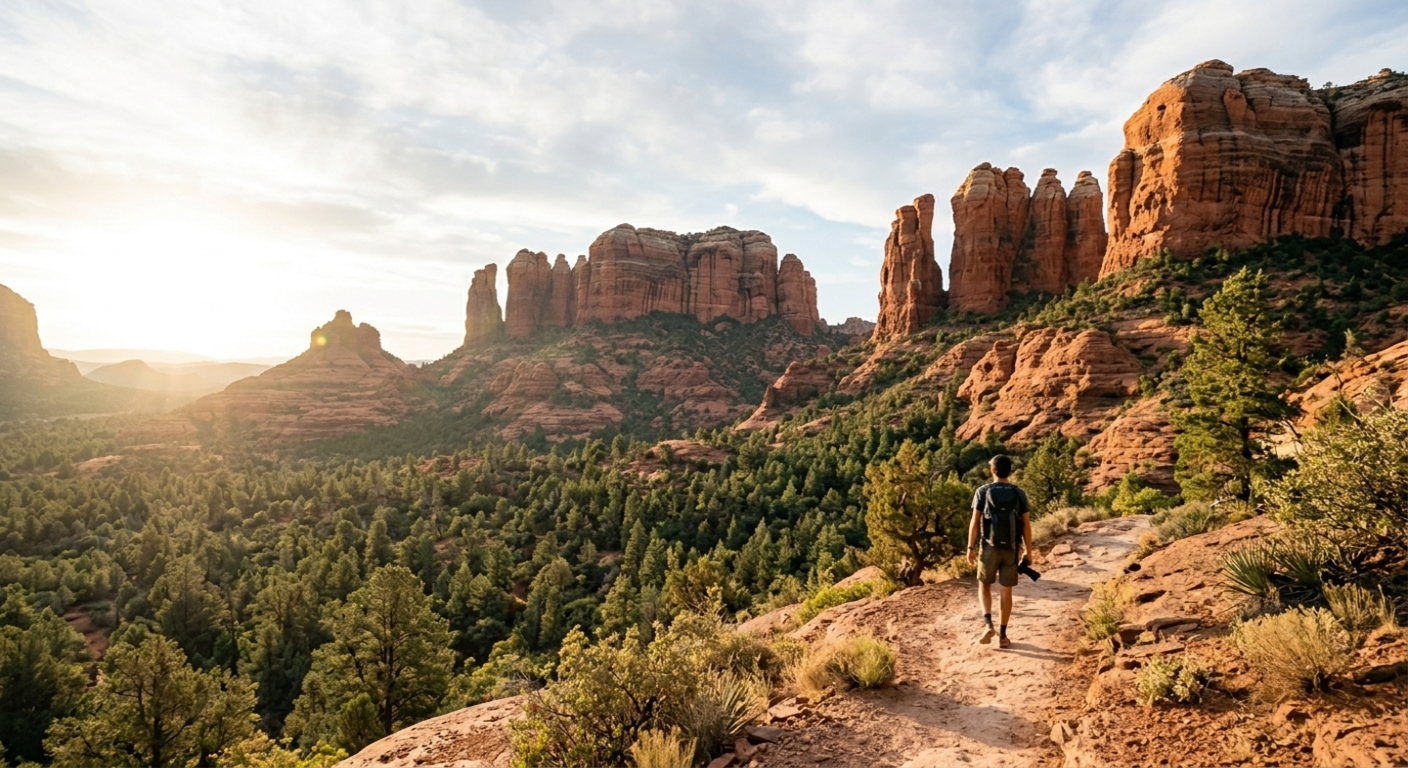
The Soldier Pass trail Sedona delivers an experience that sounds like an exaggeration. On this single trek, you see a giant sinkhole, a series of naturally carved rock pools, and a hidden cave—all in under five miles. Between Devil’s Kitchen, the Seven Sacred Pools, and the Soldier Pass Cave, this is easily one of the most feature-dense hikes in Arizona.
Here is everything you need to know before you go, including the logistical secrets that will save you from pulling into an empty parking lot at 9 AM wondering what went wrong.
If you are looking for other options, you can also check out my guide on the Best Easy Hikes in Sedona: 6 Trails Anyone Can Do.
Quick Stats (The “Should I Do This?” Table)
| Trail Detail | Info |
|---|---|
| Distance | 4.5 miles out-and-back, or 6 miles as a full loop |
| Difficulty | Moderate |
| Elevation Gain | ~450–800 ft |
| Time | 2.5–4 hours |
| Permit | Red Rock Pass ($5/day) or America the Beautiful Pass |
Why This Trail Though?
Sedona has no shortage of pretty hikes, but most of them give you one main thing—a view, a canyon, or a rock formation. The Soldier Pass trail Sedona gives you three completely different experiences on the same path.
First, you stumble onto Devil’s Kitchen, an enormous sinkhole where the earth simply gave up and caved in. Next, you reach the Seven Sacred Pools, which are smooth, sculpted basins in the red sandstone that fill with water after a desert rain.
Finally, if you are up for a challenge, you scramble up to a cave with natural rock “windows” that look like a movie set. Honestly, it feels a little unfair to other trails in the area. It offers a similar sense of discovery to the Fay Canyon Arch Hike, where finding the hidden feature is part of the fun.
Parking: The Part Nobody Warns You About
Let’s talk about the parking situation, because it will ruin your day if you’re not prepared.
The Lot Is Tiny
14 spots. The main lot has fourteen spots. For one of the most popular trails in Sedona. On a busy spring Saturday, those fill up before 8 AM, sometimes before the gate even officially opens. So yeah, showing up at 9:30 hoping for the best is not a plan. If you prefer a trail with more consistent access, consider the Bell Rock Pathway.
The 2026 Shuttle (Thu–Sun)
Sedona added a shuttle requirement on Thursdays through Sundays in 2026. The main lot stays closed to private cars during peak hours on those days, and you’re directed to use the shuttle instead. It’s not the end of the world, but you need to know about it before you’re sitting confused at a gate wondering why no one’s going in.
Driving Permit (For Weekdays)
If you want to actually drive up Soldier Pass Road to the trailhead, you need a separate motorized access permit — $6, non-refundable, through recreation.gov. Only 12 are issued per day. They go fast. Book as early as your 90-day window allows and don’t assume you’ll snag one last minute.
Three Ways Around the Whole Mess
Start from Jim Thompson Trailhead instead. You connect via the Cibola Pass trail and add about a mile to your total, but you skip the permit headaches and the residential street congestion entirely. It’s a legitimately great approach.
The “Debbie” Shuttle. Local private shuttles (regulars call them the Debbie shuttle) cover overflow areas when the main lot is full. You can book through local activity companies in town.
Go Monday–Wednesday, early. Seriously. Get there before 7:30 AM on a weekday and you’ll often find spaces no problem, plus a trail that doesn’t feel like a queue.
January mid-week is basically a different hike — in the best possible way. This is also a great time to visit the Airport Mesa Trail Sedona for sunrise views.
What You’ll Actually See on Trail
Devil’s Kitchen
You hit this one fast, and it stops you cold every time. Devil’s Kitchen is a sinkhole that’s about 150 feet long and 90 feet wide. The ground literally collapsed twice — once around 1880, and again in 1989 when it widened even more. Standing at the rim, it’s one of those moments where your brain genuinely struggles to process the scale.
Put a person in your photo if you want to convey how big it actually is, because without a reference point it just looks like a big hole. It IS a big hole. A very big hole. If you are interested in the mystical side of these formations, read my breakdown of the Sedona Vortex & Spiritual sites.
Best photography angle: northeast rim edge in the morning when the shadows are dramatic.
Seven Sacred Pools
These are naturally carved basins worn into the sandstone over thousands of years. In spring after a rainy winter, you might find them filled with two or three feet of actual water, looking serene and beautiful. In summer or fall, they’re probably more “scenic puddles.” Either way, they’re cool.
One thing you absolutely cannot do: get in the water. No swimming, no wading, not even stepping in. Rangers patrol this area and the pools are protected habitat. I know it looks tempting on a hot day. Don’t. For more family-friendly water or shade options, check out the Best Easy Hikes in Sedona: 7 Top Trails for Families.
The Cave Turnoff
This is where a lot of people accidentally blow past the cave and end up on the Brins Mesa extension wondering where the cave went. At 1.3 miles, look for a fork that goes left.
Your landmarks: a Red Rock–Secret Mountain Wilderness boundary sign and a solo juniper tree that locals call the “Wilderness marker tree.” If you miss the fork, you’ll know because the scenery stays pretty but the cave never appears. This hidden alcove experience is comparable to the famous Birthing Cave Sedona.
The Soldier Pass trail Sedona Cave Scramble (The Fun Bit)
Getting Up There
The approach to Soldier Pass Cave is a proper scramble. The gradient averages around 24% over the last third of a mile, with sections where you’re using hands and feet to climb. It’s not technical — you don’t need ropes or gear — but it’s not a stroll either. Grippy shoes aren’t optional here.
Inside the Cave
The cave is less of a cave and more of an eroded alcove with these dramatic natural openings in the rock — locals call them “windows.” Hit it between 3 and 5 PM and the light coming through creates this backlit glow effect where the rock turns amber against the sky. It’s one of the better photography moments I’ve seen on any trail, full stop.
Two things to watch out for: the sandstone gets slippery fast when wet or sandy, so hold on to something. And there’s a gap in the cave floor near the middle — look before you step, especially if you have kids with you.
Kids and Dogs — Honest Take
The cave scramble works for kids who are 10 and up and comfortable with heights and uneven ground. Younger ones can still have a great time doing the lower trail — Devil’s Kitchen and the pools are plenty dramatic without the climb.
Dogs are welcome on-leash throughout. That said, the scramble is rough on bigger dogs. Be honest with yourself about whether your lab mix actually wants to navigate steep rocky terrain. Some do, some absolutely don’t.
If you need a more level route for the whole family, the Courthouse Butte Loop Trail is a fantastic alternative.
The “I Have Extra Energy” Option: Brins Mesa Loop
If you want to turn the hike into something bigger, skip back at the cave turnoff and keep going clockwise toward Brins Mesa for the full 6-mile loop. The mesa gives you wide open panoramic views you can’t get from the canyon floor, and the crowds thin out noticeably up there even on busy days.
The route passes through an area that went through a controlled burn — charred manzanita alongside new growth, which is genuinely interesting to see. And the rock layers in the canyon walls on this section are around 250 million years old, which is the kind of fact that makes you feel small in a good way. Agave, manzanita, and pinyon pines replace the scrubby juniper as you gain elevation, so the feel of the trail changes too.
Timing and Photography Tips
For the pools: Late afternoon (3–5 PM) is the sweet spot. The light goes warm and the shadows on the surrounding rock spires soften. For Devil’s Kitchen, morning (7–9 AM) is better — the side lighting hits the sinkhole at a dramatic angle.
Spring (March–April): The most popular time. Wildflowers, green everything, beautiful — and crowded. Book permits early.
Winter: There’s a whole community of people who specifically come to Sedona in winter to photograph red rock with snow on it, and honestly I get it. It’s striking. Just bring microspikes if there’s been recent ice on the cave section.
January: Quietest month on this trail by a significant margin. If you want the place mostly to yourself, mid-week January is the move.
Pack This Stuff
- Shoes with actual grip (not sneakers — real trail runners or approach shoes for the cave)
- At least 2 liters of water per person (there’s nothing to refill from on trail)
- Offline maps downloaded before you go (cell service disappears in the canyon)
- Your Red Rock Pass or America the Beautiful Pass
- Sunscreen, hat, layers — Sedona sun is no joke
- Wide-angle lens or phone camera with a good ultra-wide mode for Devil’s Kitchen
Quick FAQ
Do you need a permit for Soldier Pass trailhead parking?
Yes. A Red Rock Pass ($5/day) or America the Beautiful Pass is required for all vehicles. Additionally, a separate $6 motorized access permit (booked via redrockcanyonlv.org) is required to drive Soldier Pass Road to the main lot — limited to 12 per day.
Can you swim in the Seven Sacred Pools?
No. Swimming and wading are strictly prohibited. The pools are a protected wildlife habitat, and violations can result in citations from forest rangers.
Are dogs allowed on the Soldier Pass trail?
Yes, dogs are permitted throughout the trail but must remain on-leash at all times. Be realistic about your dog’s ability to handle the rocky cave scramble section.
How difficult is the Soldier Pass cave scramble?
The scramble rates as moderate-to-challenging due to the steep gradient and hands-on sections. No technical climbing skills are required, but comfort with uneven rocky terrain and some exposure is essential. High-traction footwear is non-negotiable.
Is there water in the Seven Sacred Pools right now?
Water levels depend entirely on recent precipitation. Spring visits after a wet winter offer the best chance of seeing actual pooled water. In summer and fall, the basins are typically dry or contain only shallow puddles.
What is the gate code for Soldier Pass?
There is no public gate code. Access via Soldier Pass Road requires a pre-booked motorized access permit through recreation.gov. The gate is managed by permit control, not a code system — only permitted vehicles are granted entry during controlled hours.
Look, Sedona has a lot of trails competing for your attention and your permit dollars. Soldier Pass earns it. Three genuinely different experiences, a cave scramble that feels like an adventure without requiring any real climbing skill, and views that hold up even if you’ve already done a dozen red rock hikes. Just sort out the parking situation before you go. That part will make or break your morning.